See it work
The interactive piece from the front page, with room to try it, followed by Tracgen’s logo, colors and type.
g1-esp32-env-sensorsucceededI need a battery-powered WiFi environmental sensor board. ESP32-S3-WROOM-1-N8R2 module, BME280 over I2C, a 1S 500 mAh LiPo charged over USB-C, 3.3 V from an LDO, one LED and one button, 4× M2 holes. No bigger than 50 × 40 mm, 2 layers. Build quantity 100, everything in stock at Digi-Key or Mouser, unit BOM under $18.
-
00 Ingest
ingestReads the prompt and any spec documents you uploaded.
-
01 Formalize
formalizeQuick confirmTurns the brief into a BoardSpec:
env-sensor-rev-a, 2 layers, 50 × 40 mm at most, M2 holes. It can ask up to five questions.Q1. Should the I2C bus also be exposed on an expansion connector (e.g. Qwiic/JST-SH)?
Suggested: “No - onboard sensor only for rev A.”
-
02 Architecture
architectureSplits the board into blocks:
blk_usb,blk_charger,blk_battery,blk_power_reg,blk_mcu,blk_sensor,blk_led_ui. Rails go VBUS 5 V → VSYS 4.2 V → 3V3. -
03 Component search
component_searchFinds parts through Nexar, Digi-Key and Mouser, and drops anything without 5× the build quantity in stock: ESP32-S3-WROOM-1-N8R2, BME280, MCP73831T-2ACI/OT, AP2112K-3.3TRG1, TYPE-C-31-M-12.
-
04 Circuit synthesis
circuit_synthesisWorks out the supporting parts for each block, like the 5.1k pull-downs on CC1 and CC2.
-
05 Schematic
schematicWrites the KiCad schematic and runs
kicad-cli sch erc --format json. -
06 Schematic review
schematic_reviewRequired reviewYour review, with the BOM priced live, an explanation for each block, and risk flags like Low stock or Single source.
Request changes needs at least one comment. After approval, Tracgen carries on by itself. No further input is needed unless verification finds a critical issue.
-
07 Board setup
board_setupFootprints, board outline, stackup and netlist sync.
-
08 Placement
placementA hints agent suggests where parts go, then a deterministic annealer places them.
-
09 Routing
routingWrites a Specctra DSN and runs freerouting on it (
-de board.dsn -do board.ses), then rips up and re-routes any nets that fail DRC. -
10 Verification
verificationkicad-cli pcb drchas to come back with zero errors. Then netlist equivalence, rail continuity, and an AI design review. -
11 Outputs
outputsGerbers, Excellon drill, BOM, pick-and-place, PDFs and renders, zipped as
<project>-rev<r>-fab.zip.
Assets
Logo, colors, and type.
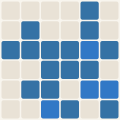
Mark
The project’s generated logo mark. The grid gets finer with the commit count, and the cells show the split between languages. It’s redrawn as the project grows.
Palette
The colors Tracgen uses across this site: one hue from its discipline’s band, plus the shades that make it work on both dark and light backgrounds.
Type
The two typefaces on the site: a sans-serif for the interface and a serif for headlines.
Next
Put Tracgen in your pipeline
Ask about hooking it up to the repositories and agents you already run.